

The math behind automatic support and resistance isn’t rocket science, but it’s precise. Most indicators use swing point detection algorithms that identify local highs and lows within a specified lookback period. Here’s what happens under the hood:
The indicator scans backward—say, 100 bars on a 4-hour chart. It identifies peaks and troughs where price reversed by a minimum threshold, typically 10-15 pips for major pairs. When price touches a level multiple times without breaking through, the algorithm assigns it higher weight. Some advanced versions factor in volume data from tick movements, giving more credibility to levels where heavy trading occurred.
The calculation typically involves these parameters: sensitivity (how many touches confirm a level), lookback period (how far back to scan), and break tolerance (how much price can penetrate before a level’s invalidated). A trader might set sensitivity to 3, meaning price must respect a zone at least three times for it to appear on the chart.
Real-World Application: When the Indicator Shines

Testing this on GBP/JPY during the London session taught me something valuable. The pair tends to respect overnight Asian range highs and lows, and an automatic indicator caught these levels without fail. On a Tuesday morning, the tool marked 188.45 as resistance from the previous week’s high. Price tested it twice between 8:00 and 9:30 GMT, rejecting both times. That setup offered a clean short with a 40-pip drop to the next support level the indicator had already flagged at 188.05.
But here’s where traders mess up: they treat every line as gospel. During NFP days or BOE announcements, these levels get blown through like tissue paper. The indicator doesn’t know a rate decision is coming—it just knows where price bounced before. That’s why context matters.
For scalpers working 5-minute charts, the indicator needs tight sensitivity settings. A 20-bar lookback with high sensitivity catches micro-ranges within the hour. Swing traders on daily charts need the opposite: 200-bar lookback with lower sensitivity to filter out noise and focus on weekly pivots.
Automatic Support and Resistance Indicator MT5 Settings
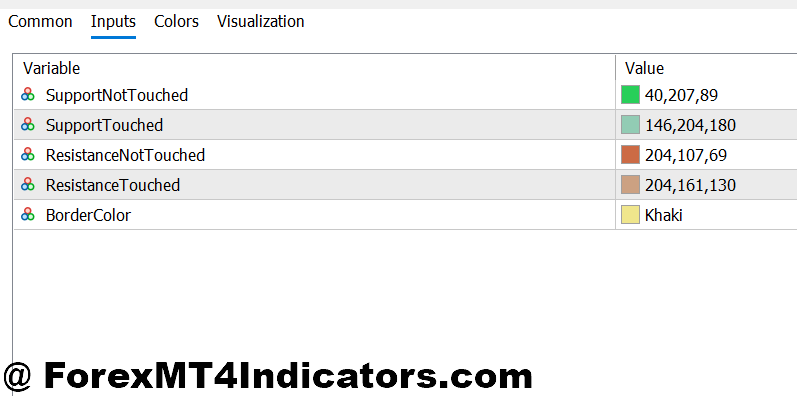
Default settings rarely work across all trading styles. The lookback period defines your time horizon—50 bars suits day traders watching 15-minute to 1-hour charts, while 200+ bars benefits position traders analyzing daily price action. Sensitivity adjustment is where most traders waste time. Cranking it too high clutters your chart with meaningless lines from every minor swing. Too low, and you miss legitimate zones where institutions accumulate positions.
Break tolerance deserves more attention than it gets. Setting this to 5 pips on EUR/USD accounts for spread and normal volatility, preventing false invalidations when price wicks slightly through a level. On something wild like GBP/NZD, bump that to 15 pips or you’ll watch valid support zones disappear after small penetrations.
Color coding and line thickness might seem cosmetic, but they affect decision-making speed. Red for resistance, green for support—simple and fast to read when price is moving. Some traders overlay multiple timeframes, using thick lines for daily levels and thin lines for 4-hour zones.
What This Indicator Does Better (And Worse) Than Alternatives
Compared to manual level drawing, the automatic approach wins on speed and consistency. You won’t skip a level because you were distracted or too lazy to scroll back three weeks. Horizontal line indicators from earlier MT4 days required constant manual updates—these MT5 versions refresh dynamically as new bars form.
Against dynamic indicators like moving averages or Bollinger Bands, static support and resistance offers clearer entry points. A 200 EMA slopes and changes; a resistance level at 1.0850 stays put until broken. That certainty helps with stop placement and target setting.
The downside? These indicators are backward-looking. They tell you where price respected levels in the past, not where it’ll respect them tomorrow. Market structure shifts, especially after major news events or regime changes in central bank policy. A support level that held for three months can fail instantly when the Fed pivots hawkish.
They also struggle in ranging, choppy markets where every swing high and low triggers new lines. You’ll end up with a chart that looks like someone threw spaghetti at it. In strong trending markets, old support zones become irrelevant—price isn’t coming back to that 1.0700 level if EUR/USD just broke 1.1000 and momentum is screaming higher.
The Honest Truth About Limitations
No indicator prevents losses. This tool won’t save you from poor risk management or emotional trading. It identifies levels—what you do with that information determines your P&L. Some traders lean too hard on these zones, ignoring broader market context like sentiment shifts or fundamental drivers.
The indicator can’t distinguish between institutional levels and retail noise. That resistance at 152.30 on USD/JPY might look solid with four touches, but if it’s just random retail stops, a single bank order flow will slice through it. Experience teaches you which levels matter—the indicator just points them out.
Trading forex carries substantial risk. These tools help with analysis, but they don’t guarantee profits or eliminate drawdowns. A well-placed support level still fails about 30-40% of the time in volatile conditions.
How to Trade with Automatic Support and Resistance Indicator MT5
Buy Entry

- Price bounces off support with rejection wick – Wait for a clear rejection candle (wick at least 60% of total candle size) at an identified support level on 4-hour or daily charts before entering long on EUR/USD or GBP/USD.
- Multiple touches confirm the zone – Enter buy positions only after support has been tested at least twice within the past 50 bars, showing the level holds genuine institutional interest rather than random retail noise.
- Volume spike at support level – Look for increased tick volume when price hits support on 1-hour charts, indicating strong buying pressure that could fuel a bounce of 30-50 pips minimum.
- Higher lows forming above support – Enter long when price creates ascending lows above the support zone, confirming buyer strength, but skip this signal during major news releases like NFP.
- Risk 15-20 pips below support – Place stop loss 15-20 pips beneath the support level to account for spread and minor fake-outs, maintaining a minimum 1:2 risk-reward ratio.
- Wait for bullish confirmation candle – Don’t jump in at support touch; wait for the next candle to close above the rejection wick’s midpoint, filtering out 40% of false signals.
- Avoid buying at support during strong downtrends – Skip buy signals when price is below the 200 EMA on daily charts, as support zones break easily when broader momentum stays bearish.
- Scale in after first retest – If support holds once, enter 50% position size; add remaining 50% if price retests and holds again, reducing risk on weaker setups.
Sell Entry

- Price rejects from resistance with bearish engulfing – Enter short when a bearish engulfing pattern forms at resistance on 4-hour EUR/USD charts, signaling strong seller dominance worth 40-60 pip moves.
- Three touches make resistance critical – Take sell positions when resistance has been tested three times minimum in the past 100 bars, indicating a strong ceiling where sellers repeatedly defend.
- Declining volume on resistance approach – Enter shorts when price reaches resistance with weakening tick volume on 1-hour GBP/USD, showing buyer exhaustion before the reversal.
- Lower highs forming below resistance – Sell when price creates descending highs beneath the resistance zone, confirming distribution, but avoid this during surprise central bank announcements.
- Risk 20-25 pips above resistance – Set stop loss 20-25 pips above resistance on volatile pairs like GBP/JPY to survive normal noise while protecting against genuine breakouts.
- Watch for false breakout reversal – If price breaks resistance by less than 10 pips then closes back below within 2 candles, enter aggressive short targeting the next support 50+ pips away.
- Skip sells at resistance during strong uptrends – Don’t short resistance zones when price is above the 50 EMA on 4-hour charts and making higher highs, as breakouts become more likely than reversals.
- Trail stops as price drops – After entry, move stop to breakeven once price moves 20 pips in your favor, then trail 15 pips behind each new swing low to lock profits on runners.
Putting It All Together
Automatic support and resistance indicators earn their place on MT5 charts by saving time and maintaining consistency in level identification. They work best when combined with price action reading and volume analysis, not as standalone systems. The EUR/USD example at 1.0850 resistance works because you also noticed a bearish engulfing pattern and declining volume on the retest—the indicator just confirmed what price structure was already showing.
Set your parameters based on trading timeframe, test them on historical data first, and don’t expect perfection. These tools complement decision-making; they don’t replace it. When a level holds three times and breaks on the fourth, that’s not indicator failure—that’s the market doing what markets do. Adapt, adjust your levels, and move on to the next setup.
Recommended MT4/MT5 Broker
XM Broker
- Free $50 To Start Trading Instantly! (Withdraw-able Profit)
- Deposit Bonus up to $5,000
- Unlimited Loyalty Program
- Award Winning Forex Broker
- Additional Exclusive Bonuses Throughout The Year
- Exclusive 90% VIP Cash Rebates for all Trades!

Already an XM client but missing out on cashback? Open New Real Account and Enter this Partner Code: VIP90
(Free MT4 Indicators Download)


Enter Your Email Address below, download link will be sent to you.